
The First Ten Minutes
What to Do at the Scene of an Atlanta Car Accident
Most people freeze after a crash. Your hands are shaking, your ears are ringing a little, somebody is honking behind you, and the part of your brain that handles decisions has gone quiet. That is normal, and nobody should feel bad about it. The problem is that the first ten minutes at the scene are the only ten minutes you get. Everything that happens after, the claim, the adjuster, the fight over who did what, gets built out of whatever you managed to capture while you were standing there in traffic.
Some of what I am about to tell you, you already know. Call the police. Take pictures of the damage. Get looked at by a doctor. Those are the basics, and most people at least know they are supposed to do them. But there are two or three things in here that almost nobody thinks about in the moment, and those are the ones that separate a clean claim from a claim we spend the next year fighting over.
Here is the frame I want you to keep in your head for this entire chapter. If you are not at fault, the police are your best friend. Not an inconvenience, not a hassle, not somebody who is going to make this take longer than it needs to. Your best friend. Everything at the scene should be organized around making the officer's job easier and making sure their investigation captures what actually happened.
When you're doing that, don't narrate. So people don't think about that. I get the video and then you're saying a bunch of stuff. The other side's gonna hear all of that, and you don't want that. Just remain quiet, let the video speak for itself.
Call the Police Every Single Time
This is number one for a reason. In my opinion you call the police every single time, no matter what kind of accident you were in and no matter how small it looks standing there in the road. Chapter 2 is entirely about why, because it is the single easiest mistake to make and one of the most expensive, and I have a case I want to walk you through. For right now, just take it as the first move. You are in an accident in Atlanta, you call the police.
The officer who shows up is trained to investigate. They talk to the drivers, they talk to the witnesses, they look at the road, and they determine right then who they believe is at fault and why. That determination becomes documented proof. It does not just help you argue your case, it becomes the case, and if this thing ever gets in front of a jury, that officer is the expert you get to put on the stand.
Keep the Vehicles Where They Are, and Shoot the Video Before You Move Anything
The default is that you leave the cars exactly where they came to rest, you get yourself off to the side of the road, and you wait for the police. Let the officer be the one who tells you to move the vehicles to the shoulder or into a parking lot.
Now, safety wins over everything I just said. If you are sitting in a live lane on the highway, get off the highway. If you are on a two lane road with cars stacking up behind you and it feels dangerous, pull over. I am not asking anyone to stand in traffic to preserve a claim.
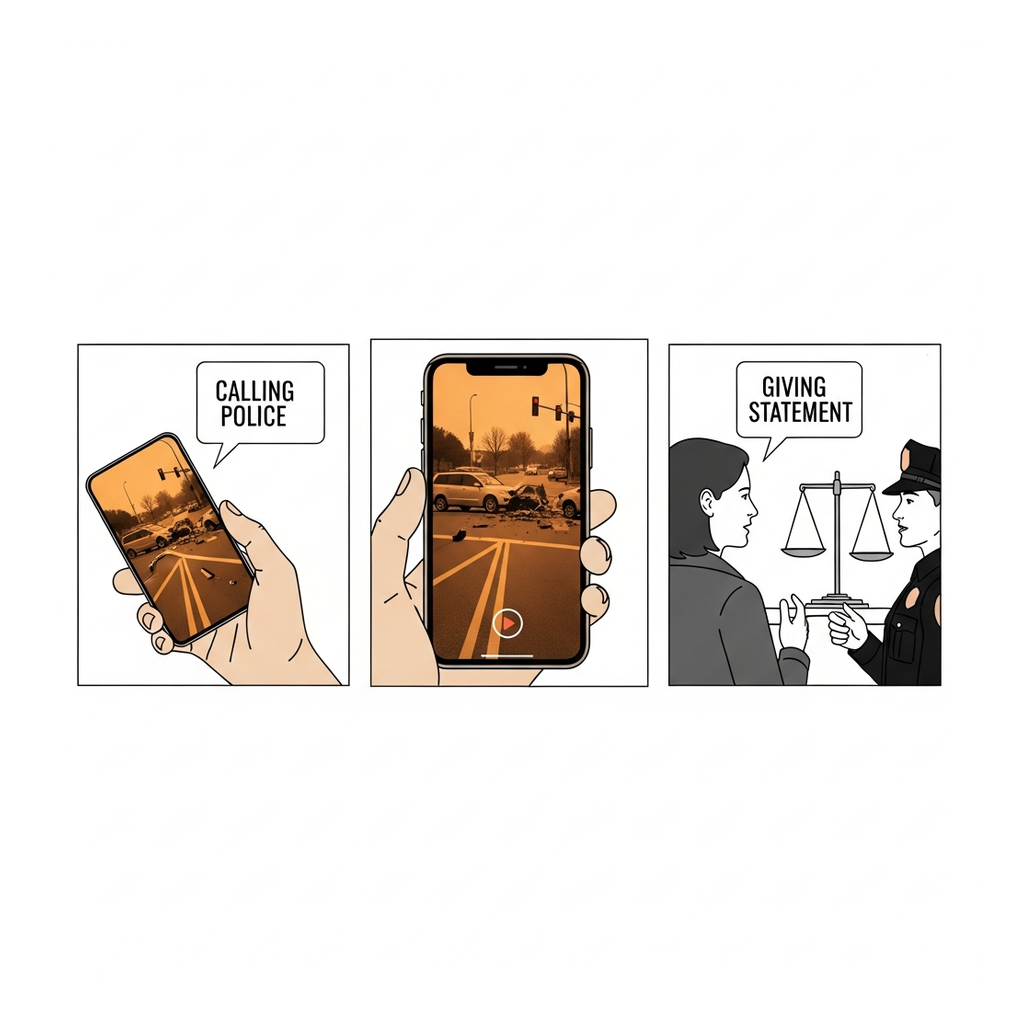
But here is the piece people miss. Before you move anything, if you can do it safely, take a quick video of the scene exactly the way it sits. The cars where they stopped, the angles, the debris, the intersection, the traffic lights or the stop signs, the whole view. Because when that officer rolls up eight minutes later, the scene is not the scene anymore. The cars are on the shoulder, the debris has been kicked around, and they are reconstructing something they never saw. You can hand them your phone and show them what it looked like at the moment of impact. It will help them with their investigation, and their investigation is what you are going to be living with.
Let the Video Do the Talking
Almost everybody is carrying a phone with a very good camera on it. Use it. Photographs of the damage are the thing people remember to do, and you should absolutely take them. But video captures things a still photo never will. Get the damage to both vehicles, the debris field, the roadway, the intersection, the signals, the sight lines. Walk it and get a whole view of the scene rather than a handful of tight shots of your bumper.
Then the part that nobody thinks about. Do not narrate.
I know the instinct. You are recording, you are keyed up, and you start talking through what you are seeing and what you think happened and what the other driver did. Stop. That audio is on the video, and the video is going to end up in the other side's hands. They will hear all of it, including the sentence you did not think twice about, and they will build an argument out of it. Just stay quiet and let the video speak for itself.
Make Sure the Officer Actually Hears From You
You would think this one is obvious. Of course you are going to talk to the police. But I talk to people constantly who tell me the officer never came over and got their side of the story, that they only spoke to the other driver. Sometimes there is a good reason for it. You were in the back of an ambulance getting checked out by EMS while the officer was writing up the other guy's version. Sometimes there is no reason at all.
Either way, do not assume the officer got your account. If they have not come to you and they are still on scene, go to them. Walk over and give them your side. You have to give them your side of the story, because their report is being written from whatever they were told, and if the only version they heard belongs to the other driver, that is the version the report reflects.
Get Checked Out as Soon as You Can
The last of the basics, and the one people talk themselves out of most often. Go get treatment as soon as you can, same day if there is any way to do it, even if you feel more or less fine standing there in the parking lot. Adrenaline is doing a lot of work in the first hour after an accident, and what you feel at the scene is not a reliable read on what you are actually dealing with. There is a whole chapter on this later, including the hierarchy of where you should go and why insurance companies grade you on it. For now, just go.
Common Questions
- What should you do first after a car accident in Atlanta?
- Call the police. That is the first move every single time, no matter how minor it looks. After that, keep the vehicles where they are if it is safe, video the scene before anything gets moved, photograph the damage, make sure the officer personally takes your side of the story, and get medical treatment as soon as you can. Those are the basics, in that order.
- Should you move your car after an accident in Georgia?
- Not unless safety requires it. The default is to leave the vehicles where they stopped and let the officer tell you when to move them. Obviously, safety comes first. If you are on a highway or a two lane road where sitting there is dangerous, pull over. Just take video of the scene the way it sits before you do, so the officer can see what you saw.
- Should you talk while you are recording video at the scene?
- No. Record silently. Whatever you say on that video, the other side is going to hear, and an offhand comment made while your adrenaline is up can be turned into an argument that you were partly at fault. The images are what you want. As I tell people, just remain quiet and let the video speak for itself.
- What if the police only talked to the other driver?
- Go over and talk to them yourself before they leave. It happens more than you would think, sometimes because you were being evaluated by EMS while the officer was taking statements. The report gets written from what the officer was told. If your version never reached them, it does not exist in the document that every adjuster and every jury is eventually going to read.
Chapter Reflection
Almost everything in this chapter costs you a few minutes and nothing else. Waiting on an officer, holding your position until you are told to move, thirty seconds of silent video, one conversation you make sure to have before anyone drives away. None of it feels urgent while you are standing in the road wanting to be anywhere else. The reason it matters is that an accident claim is decided by people who were not there. An adjuster, and sometimes twelve jurors, are going to reconstruct your ten minutes out of a report, some photographs, and whatever else survived. You are the only person at the scene with the ability to make that record accurate. The next chapter takes the very first item on the list and pulls it apart, because "it is minor, let's just exchange information" is the moment where most of the damage gets done. The scene checklist in this chapter comes from the original conversation this book was adapted from.