
Who Decides Fault
The Police Report, the Jury, and the Evidence Between Them
Most people walk away from a wreck believing the officer settled it. He wrote the other driver at fault, so the other driver is at fault, and that is the end of the discussion. That is not how it works in Georgia, and understanding why changes how you behave at the scene and in the months after.
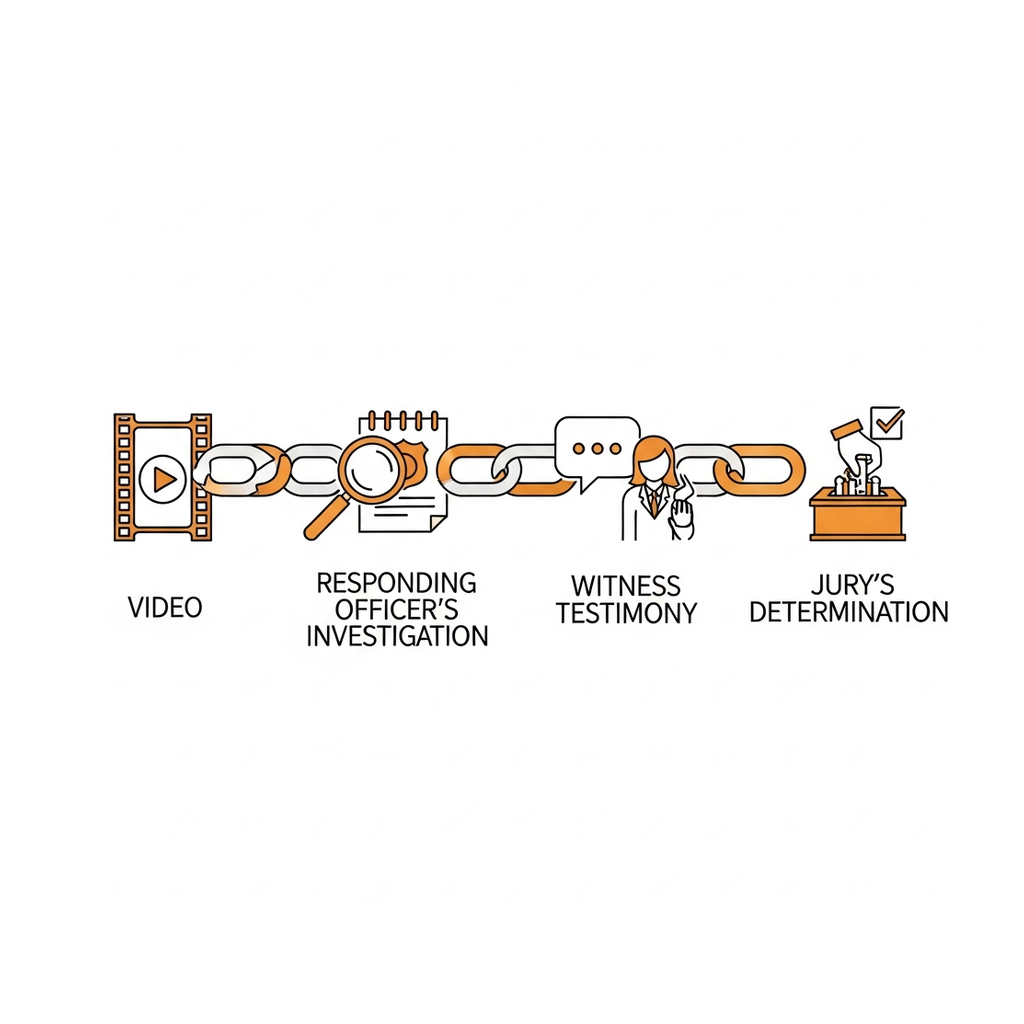
Fault is ultimately determined by the jury. Twelve people from your community sit in a box, look at the evidence that gets presented to them, and decide who they believe caused this. That is the real decision-maker in your case, and everything else is material you hand them so they can make it.
Now, because Georgia is a comparative negligence state, that jury is answering two questions instead of one. They decide who is liable, and they decide at what percentage. The defense is always working the second question. They want that percentage moved off their driver and onto you, all the way up to one hundred percent on one side and zero on the other if they can get it.
So you got to have the officer out. They're your best friend. They are trained to investigate the wreck, talk to all the witnesses, and determine right then and there who they believe is at fault and why. They then become your expert you call to trial and let the jury hear from the officer.
Video Is First and Best
How do you prove fault to twelve strangers? The first and absolute best way is video. That is why I say video, video, video until people are tired of hearing it from me.
If you get video of the entire wreck, the video says everything. It does not matter what the officer wrote. It does not matter what the witnesses said or how confident they sounded. The jury watches the wreck happen and determines who is at fault by looking at it. There is no argument left to have.
Look, I have to be straight with you about how often that happens. It is very rare that we have video of the accident itself. Most cases do not produce it. It is worth every bit of effort at the scene to find out whether a nearby business camera caught something, because when it exists it is the best evidence in the file. But you cannot plan your case around evidence that usually is not there.
The Officer Is the Expert You Call to Trial
So normally, fault comes down to the officer. That is the whole reason I tell people to call the police every single time, even for a scratch.
They are trained to investigate the wreck. They talk to the witnesses. They look at where the vehicles are, what the damage pattern shows, what each driver says, and they determine right then and there who they believe is at fault and why. That determination gets documented while everything is fresh, by someone with no stake in the outcome.
That officer then becomes your expert at trial. You call them, and the jury hears it from the person who was actually standing in the road that day. I found this driver fully at fault, and here is why. They ran the red light. They did not have their blinker on when they turned. It was a rear-end collision. That testimony carries weight that no amount of argument from me carries, because it comes from a neutral professional whose job was to figure out what happened.
There is one thing to keep straight about what the officer is doing. Their duty is not to compare fault. They are not out there deciding that one driver is sixty percent responsible and the other is forty. They figure out who is at fault, meaning who is the majority at fault, and they write it that way. The percentage work belongs to the jury, and it happens much later, under the threshold rules covered earlier in this book.
That distinction matters in both directions. A driver marked at fault at the scene has not been assigned a number, and a driver cleared at the scene has not been guaranteed one either.
What Happens When There Is No Officer
If you do not have the officer, you are in he-said-she-said. Two drivers, two versions, no neutral third party who wrote anything down while it was fresh.
That case is not automatically lost. It is a much harder case. You had better have witnesses, and you had better have their full contact information rather than a first name and a guess. You had better have video. And you had better have a good way to explain to a jury why you are not at fault and the other party is.
I would say that is the position nobody wants to be in, and it is the most avoidable one in this entire book. The officer showing up costs you thirty or forty minutes at the scene. Not having the officer can cost you the case.
Common Questions
- Does the police report decide who is at fault in Georgia?
- No. Fault is ultimately determined by the jury, twelve people from your community looking at the evidence presented to them. The police report is powerful evidence and the officer is the expert you put in front of that jury, but the report itself is not the final ruling. Insurance companies treat it as close to final in most claims, which is why it carries so much practical weight.
- Can I still have a case if the officer found me at fault?
- Possibly, but I want to be careful here. The officer's job is to identify who is the majority at fault, not to assign percentages, so their finding is not the last word. It is rare to have an officer find you at fault and still be able to shift enough fault onto the other driver. If you are severely injured, it is worth having a lawyer look at whether the evidence supports it.
- What is the best evidence for proving fault in a car accident?
- Video of the wreck itself, without question. "If you get video of the entire wreck, video speaks everything." When it exists, it ends the fault argument outright, because the jury can watch what happened instead of choosing between two stories. It is rare, which is why the responding officer is the evidence most cases actually run on.
- What if no officer came to the scene?
- Then you are relying on witnesses, video, and your own ability to explain the wreck to a jury. Get every witness's full name, phone number, and email before anyone leaves. Some jurisdictions in the Atlanta area no longer send officers to wrecks without injuries, so this scenario is more common than it used to be.
Chapter Reflection
The thread running through all of this is that fault is not a fact somebody hands you at the scene. It is a conclusion that twelve people reach, months or years later, from whatever evidence made it into the file. Everything you do in the first hour is really about what those twelve people will eventually get to see. The video you take. The witness whose number you wrote down. The officer you made sure spoke to you and not just the other driver. None of it feels consequential standing on the shoulder of the road. All of it is the case. Proving fault is one half of the work. Opening the claim and dealing with the people on the other end of the phone is the other half, and that is where good, honest people give away ground they never meant to give. Ted covers evidence and police reports further across the firm's accident law blog.