
The 51 Percent Rule
How Comparative Negligence Decides What You Recover
There is one number in Georgia car accident law that decides whether a claim is worth everything or worth absolutely nothing. Not less. Nothing.
Most people have some fuzzy sense that being partly at fault reduces what they get. That is half right, and the half that is missing is the part that ends cases. Georgia's rule has a floor built into it, and below that floor the reduction is not a discount. It is a zero.
This chapter does the arithmetic, walks through a case out of Cumming where my client got the ticket and still recovered, and corrects something almost everyone believes about what a police officer at the scene is actually deciding.
The Threshold That Decides Whether You Have a Claim
Two things are happening in Georgia's comparative negligence rule, and they run in order.
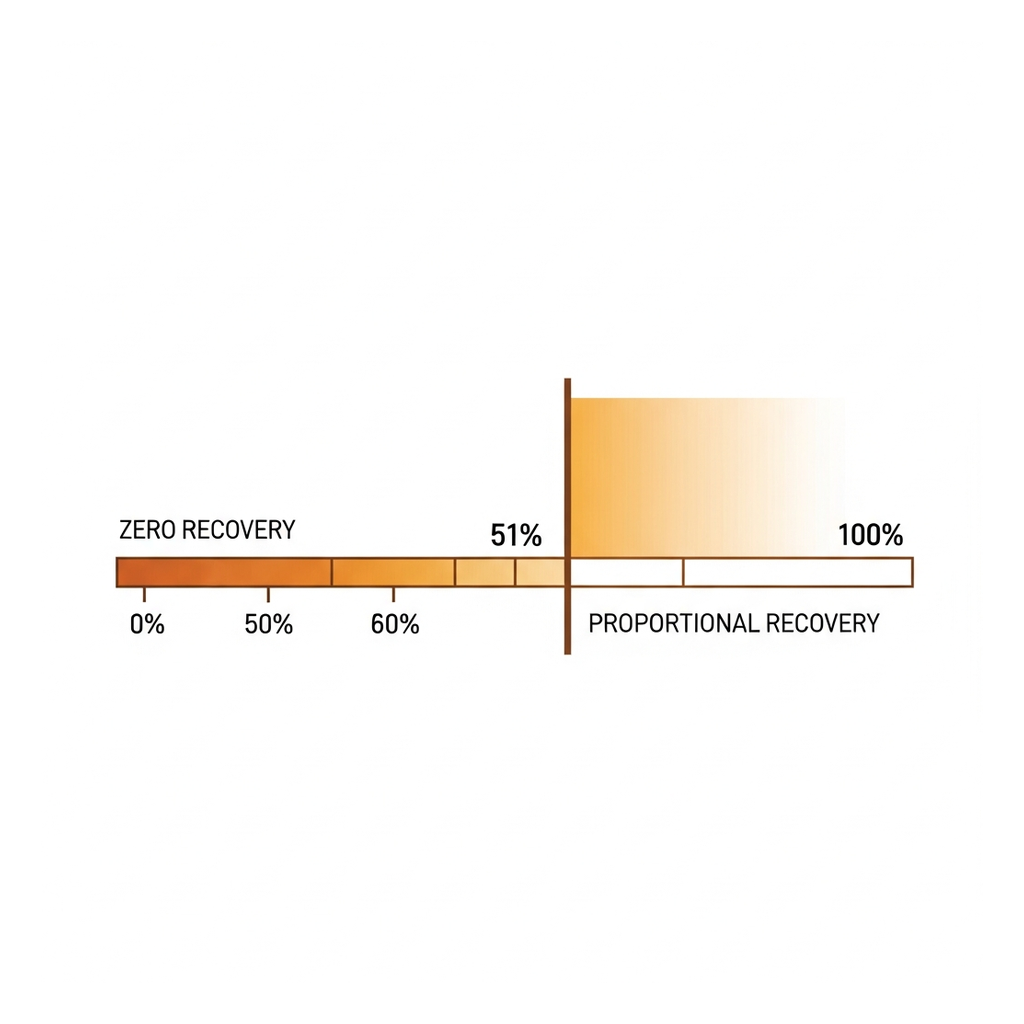
First, you have to hit the minimum threshold to have a case at all, meaning to get any recovery. That threshold is fifty-one percent. The at-fault driver has to be fifty-one percent or more at fault for you to recover something.
Second, once you are above that threshold, you recover the percentage of fault placed on that other party.
Now, where it gets scary is the first part, because it does not work in the alternative. If you cannot prove fifty-one percent, you get zero. Prove they were forty-five percent at fault and you get nothing. Prove twenty percent, nothing. There is no partial credit below the line.
And this is not a theoretical risk. Oftentimes it is fifty-fifty. It is he said, she said, and a jury looks at it and goes, I cannot figure out who is at fault, so I am just going to throw a fifty on each party. That feels like a fair, splitting-the-difference outcome to twelve people in a jury box. It means zero for the plaintiff. You recover nothing at fifty percent or below.
Above the Line, You Recover Your Percentage
Once you clear fifty-one, the question changes from whether to how much, and the math is straightforward.
Say there is a fight over who did what. A jury ultimately says, we believe the other party was sixty percent at fault, and you, ma'am, are forty percent at fault. You recover, but you do not recover one hundred percent of your damages. You recover sixty percent, the percentage of fault put on that driver.
Put real numbers on it. You have one hundred thousand dollars in medical bills and lost wages. The jury awards the full one hundred thousand dollars. Then the judge reduces the award by the percentage of fault assigned to you. You collect sixty thousand dollars. The other forty thousand is your fault, and you carry it.
You always want to try to prove they are one hundred percent at fault, so you get full recovery of all your damages. If you cannot, you get whatever percentage you can establish above the line, whether that is sixty-five, seventy-five, eighty-five, or ninety-five.
We were able to prove that speed, and that was a factor, and our argument was, 'Yeah, we get it. Our client's not zero at fault. She was over the line, and she shouldn't have been.' But had the driver not been going 70 miles an hour, they would have seen that and been able to easily avoid it. There was no other reason to run into this woman.
A Case in Cumming That Started With My Client Getting the Ticket
I had a client in Cumming, Georgia. She was ticketed and found at fault by the officer at the scene, which by itself is where most people would have stopped.
Here is what happened. She was waiting in line at a red light, and her tires were over the yellow line. A car came in the opposite direction and hit her head-on. The officer looked at it and said, well, you are over the yellow line, you are at fault. He marked her at fault and gave her a ticket.
She came to us anyway, and what she told me was that this car came up over a hill in the other direction, in a thirty-five mile an hour zone, doing something like seventy miles an hour. And it was crazy, Ted. So we looked into it, and my first reaction was the honest one, which is that they found her at fault.
We were able to prove that speed. That was the factor that changed the case.
Our argument was never that she was blameless. We got it. Our client was not zero at fault. She was over the line, and she should not have been. But had the driver not been going seventy miles an hour, they would have seen that and been able to easily avoid it. There was no other reason to run into this woman. You cannot see the cars sitting right there and hit them, unless you are coming up over a hill going far too fast to react.
We resolved that case before trial, because the other side did the same math I was doing. They saw it as, Ted might be able to prove fifty-one percent fault for speed. A jury is going to put something on Ted's client, but what if it is not fifty percent or more? If a jury put fifty percent or more on her, my client got zero. They saw the risk, my client rightly pursued it, and she recovered some of her damages.
She needed it. She had been in the hospital for a couple of months, with hundreds of thousands of dollars in damages. She was really, really hurt. If she had accepted the ticket as the final word, she would have collected nothing at all.
What the Officer Is Actually Deciding
This is the piece people get wrong, and it is worth being precise about.
The officer's duty is not to compare fault. It is not their job to say, I believe they are sixty percent and you are forty. They do not do percentages, and no percentage exists on that report. They figure out who is at fault, meaning who is the majority at fault, and they write that down.
So a citation is one trained person's read on who was mostly responsible. It is real evidence and I never wave it off. But it is not the apportionment that decides your recovery, because apportionment happens later, in front of a jury, with everything the officer did not have at the scene. In Cumming, what the officer did not have was the other driver's speed.
Just because you are found at fault by the officer does not mean you do not have a case. I want to be careful here, though, because I have seen people run too far with that. There has got to be some real stuff there. It is rare that a police officer says you are at fault and you are then able to find something that puts fifty-one percent on the other party. But it can happen. If you are severely injured, it is worth letting a lawyer look at it and tell you honestly whether they think they can prove it.
Common Questions
- What is Georgia's 51 percent rule?
- It is the minimum fault threshold for recovering anything. The other driver has to be fifty-one percent or more at fault before you collect a dollar. Above that line, you recover the percentage of fault assigned to them. Below it, you recover nothing at all, which is why the number matters more than any other figure in a Georgia claim.
- What happens if a jury finds both drivers 50 percent at fault?
- The plaintiff gets nothing. This happens more than people expect in a he said, she said case, because a jury that cannot sort out the story often splits it evenly. A jury looks at it and goes, I can't figure out who's at fault, so I'm just gonna throw a fifty on each party. That feels balanced in the jury room and functions as a total loss for the injured driver.
- Can you still recover if you were partly at fault for the accident?
- Yes, as long as you can put fifty-one percent or more on the other driver. Sharing some fault reduces your recovery by your percentage rather than eliminating it. If a jury finds them sixty percent responsible on a hundred thousand dollar award, you collect sixty thousand and absorb the rest. The threshold is what you are aiming at, not perfection.
- Does getting a ticket mean you lose your car accident claim?
- Not necessarily. An officer determines who is the majority at fault, not what percentage each driver carries, so a citation does not settle apportionment. That said, overcoming one is rare and it takes real evidence, like proving the other driver's speed. If you were seriously hurt and got the ticket, have a lawyer look at it before you assume it is over.
Chapter Reflection
Comparative negligence is the reason a Georgia claim is never a simple yes or no. It is a scale, and there is a trapdoor at the middle of it. What that means for you is worth stating plainly. Being partly responsible does not end your claim, and being blamed at the scene does not end it either. What ends it is landing at fifty percent or below when the fault finally gets assigned, which is exactly why the evidence work in the first days matters as much as it does. My client in Cumming had a ticket in her hand and a couple of months in a hospital bed. The difference between zero and a real recovery was a speed we could prove. That is usually what the difference is. For claims in north Fulton, the firm's Alpharetta attorneys handle comparative fault disputes like this one.