
Settle or Sue
Risk, Litigation, and the Decision Only You Can Make
There are two questions I get more than any others, and they usually arrive together. Should I take this offer or file a lawsuit? And if I file, how long is this going to take?
I will give you the honest answer to both, starting with the one clients like least. Whether to settle or file is ultimately a personal decision. People do not want to hear that. I understand why. You are the victim, you did nothing wrong, and you want somebody with twenty years of experience to just tell you the answer.
But it is a personal decision because it is a business decision first and an emotional one second, and I am not the one who has to live inside either of those. My job is to make sure you know every piece of what you are choosing between, give you my honest read, and then advocate as hard as I can for whichever road you pick.
Because you can always, no matter what that number is, in my opinion, unless it's the full amount of the policy limit, you can always do better. You can always do worse, right? There are no guarantees on either side.
The Business Side: Is the Offer High Enough to Avoid the Cost of a Lawsuit?
Start with the arithmetic, because it is the part you can actually see.
Filing a lawsuit costs money, and that money comes out of the settlement or the verdict. Court fees. Deposition costs. If the case goes all the way, trial expenses to get the thing in front of a jury. None of that exists while you are still in a pre-suit claim, and all of it exists the day you file.
So the first question is simple to state. Based on your lawyer's advice, is that settlement high enough to avoid the additional costs of filing and pursuing a lawsuit? Sometimes the answer is obviously yes, the offer is strong and litigation would spend a chunk of it chasing a marginal improvement. Sometimes the answer is obviously no, the offer barely covers what you already owe.
That is the clean part of the decision. It is also the smaller part.
The Personal Side, and Why I Will Not Pretend It Is Painless
Going through litigation is not fun. They do that on purpose. It is financial and emotional warfare, and anyone who tells you otherwise is selling you something.
If we drag this out for years in litigation, are you going to get frustrated and sick of the process? Are you going to sit for a deposition and answer questions from a defense lawyer whose entire job that day is to find the sentence he can use against you? Are you going to get up on the stand in front of twelve people and a judge to try to win your own case?
Some people can. Some people cannot. Both answers are fine, and neither one makes you a bad person.
Here is the part that surprises clients. If you are the type of person who genuinely cannot go through that, then that same settlement is worth more to you than it would be to the next person. The number on the page did not change. What changed is the price you would pay to chase a bigger one.
I have had people tell me flatly, Ted, I will never file a lawsuit, I just cannot do it. Fine. Then we go get the maximum settlement offer we can, and we take it, because at that point you do not have any pressure to apply. The only real pressure a claimant has is the credible willingness to file and, if it still does not get better, to try the case to a jury.
After Two Decades, Here Is What I Can and Cannot Promise You
Now the risk, and I am going to be blunt because it is the single most important thing in this chapter.
Unless the offer is the full amount of the policy limit, you can always do better. You can also always do worse. There are no guarantees on either side of that line, and any lawyer who guarantees you one is guessing.
I have taken cases to trial thinking there was no way I could beat the last offer, and we came back with two, three, four times that number. I have also gone in certain we were going to multiply an offer, and the verdict landed right at it, or below it. Both of those things have happened to me, and I have been doing this for over twenty years.
So it also comes down to a question about you. Are you a risk taker? I am one, because that is what I do for a living. I am here to advocate for you. If you tell me you want to file and try the case, and it makes rational sense that you could do better, let us go do it. But you have to be comfortable with who you are, because you are the one carrying it.
The $550,000 Offer and the Four Day Trial
Let me give you a real one.
Nothing good was offered pre-suit. So we put it into suit. We litigated that case for several years, mainly because the client was still treating and had some big injuries, and I was not going to try it before we knew what those injuries actually were.
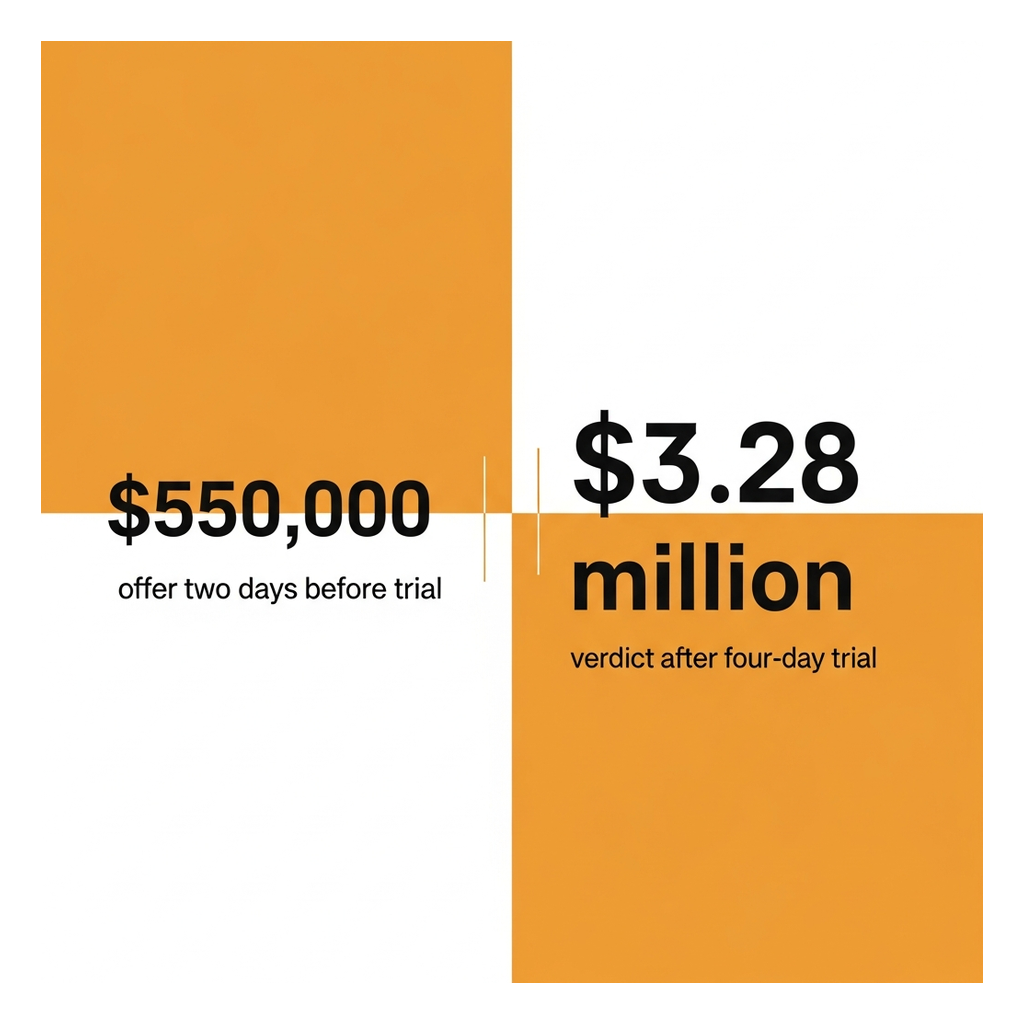
Two days before trial, the offer came in at $550,000.
My advice to him was straightforward. Look, we are ready to try this case. It took them this long to even offer you that, and it barely pays your medical bills and your expenses. Functionally it is a zero offer to you. I do not see why you would take it. But it is your decision, and if you are terrified of trying this case and you want the $550,000, I can never promise you it gets better. I felt real confident we could do better than $550,000. That is not the same as knowing.
He said no. He wanted to try the case.
Four day trial. The jury came back at $3.28 million. That verdict and others like it are published among the firm's car accident case results.
That client had past, present, and future across all of the categories in the last chapter. Permanent surgery with hardware in his neck. Lost wages. Permanent impairments. No punitive damages claim in that case, just the standard buckets, built correctly and presented to twelve people. And it was life changing for him.
What actually happened there? The insurance company simply thought they had a better case than they did. And my client was willing to take the risk.
I know some lawyers run this differently. They work purely off the number and they will tell a client when they are settling. I completely get it, and it is a legitimate strategy. I am more of a personal person about it, because after doing this as long as I have, I genuinely care about my clients, and I do not want to put anybody through something they cannot go through or do not want to go through. You have to be willing to fight. If you are not, that is okay. You just have to know it about yourself before you file.
What Litigation Actually Takes in Fulton County
I tell every client the same thing before we file. Do not file a lawsuit unless you are willing to take it all the way.
In Fulton County, from the day you file, best case scenario is about a year to try your case to a jury. More likely, two plus years.
What drives that? The biggest factor is which judge you draw. There are a number of judges across the state and superior courts, and what matters is what that judge's docket looks like when you file and what it looks like over the life of the case, because it changes. Their biggest areas are criminal and divorce, and those take precedence. Civil cases are kind of the red headed stepchildren. We come last.
Before any of that, you have at least six months of automatic discovery in most courts. That is where depositions get taken and written questions go to each side so everybody learns the case and the evidence. Six months sounds like plenty. In the legal profession it is not. Defense lawyers carry hundreds of cases, and it is close to impossible to get anything scheduled. On our side we would love to run straight through it, close discovery, get on the trial calendar and try the case. What actually happens is extensions and the deposition that cannot get set, and six months quietly becomes eight months to a year.
There is one more thing that stretches the timeline, and it is not the lawyers' fault. I will not try a case before the client's big ticket treatment is finished. If you are heading toward surgery and still working through physical therapy first, I have to have that surgery in the can before we go in front of a jury. Jurors do not like being told a surgery is coming in the next month, because the other side stands up and says, well, what if he never gets it? I have two clients in exactly that position right now, with doctors trying everything else first, and all of us knowing where it ends up. I am ready to try those cases the day the treatment is done.
Common Questions
- Should I settle my car accident claim or file a lawsuit?
- Ultimately it is a personal decision, and clients rarely like hearing that. It is a business decision, because court fees, deposition costs, and trial expenses all come out of a settlement or verdict. It is also an emotional one, because litigation is financial and emotional warfare by design. If you're the type of person that can't, well then maybe that settlement is more worth it than it would be to the next person.
- Can my lawyer guarantee I will do better at trial than the offer on the table?
- No, and be careful with anyone who says otherwise. Unless the offer is the full policy limit, you can always do better and you can always do worse. I have multiplied offers I did not think I could beat, and I have watched verdicts land at or below offers I was sure we would beat. There is always risk on both sides of that decision.
- How long does a car accident lawsuit take in Fulton County?
- From the day you file, best case is about a year to get to a jury, and more likely two plus years. The biggest variable is which judge you draw and what their docket looks like. Criminal and divorce cases take precedence over civil, so we tend to come last. Plan for a long fight, not a short one.
- Why does discovery take longer than six months?
- Because scheduling is the bottleneck, not the work. You get at least six months of automatic discovery for depositions and written questions to each side. Defense lawyers carry hundreds of cases, so getting anything on a calendar is difficult, and extensions pile up. Oftentimes, 6 months becomes 8 months to a year of just that.
- Why won't my attorney set the case for trial before my surgery?
- Because a jury needs to see finished treatment, not planned treatment. If I tell twelve people a surgery is coming next month, the other side stands up and argues it may never happen at all. I need the surgery done and the bills in hand before we try the case. That is often what stretches a timeline, and it is worth the wait.
Chapter Reflection
Nobody can hand you this decision. The best I can do is make sure you are choosing with a full picture, which means the offer, the litigation costs that come out of it, the years, the deposition, the stand, and the honest truth that it can go up or down from here. The client who turned down $550,000 was not braver than anyone else. He knew what he was made of, and he was willing to carry the risk that came with it. Somebody else in that same chair takes the $550,000 and sleeps fine, and that is a legitimate answer too. What is not legitimate is making that call without advice. Which brings us to the last question in this book, and the one people wait too long to ask. The $550,000 offer and the verdict that followed are discussed in Ted's own account of the case.