
The Insurance Playbook
How Carriers Argue Your Injuries Away
There is very little improvisation in how an insurance company handles your claim. The adjuster assigned to your file has a set of arguments, and they run them in roughly the same order every time. After more than twenty years of this, I can usually tell you what the letter is going to say before it shows up.
I want to walk you through those arguments in the order carriers actually use them, because most people brace for the wrong fight. They assume the whole case is going to be a brawl over who caused the accident. That is almost never where these cases are won or lost.
The fight is about your injuries. Whether you have them, whether this wreck caused them, and whether the treatment you received was legitimate. Nearly everything an adjuster does is a variation on those three questions.
They love preexisting conditions. They will create it out of thin air in some cases. What does that mean? If you've got a history of back pain, even if it was years before and you hadn't had back pain for years, they're gonna bring that up.
They Start With Fault, and Usually Come Up Empty
The first thing an adjuster looks for is any percentage of fault they can put on you. Obviously they would love to say you are 100 percent at fault. That is not normally what these cases are about.
Here is why. If you have called a lawyer, you typically already have a police report that says the other driver caused the wreck. The officer came out, investigated, and made a finding. That is documented proof, and the carrier knows it.
So they go hunting instead. They are looking for anything, whether it is a recorded statement, something you said at the scene, an offhand comment to the adjuster, that lets them argue you contributed. "I know they found my guy at fault, but I think you did this, and you could have done that, and we are going to put a percentage of fault on you."
Now, I want to be straight with you about how often that works, because the calibrated version is more useful than the scary version. It does not come up often. I would say 90 percent plus of our cases at Spaulding Injury Law have no real argument on those points. That is the good news. The bad news is what comes next.
The Real Fight Is Damages
What most of these cases actually come down to is damages. Are you injured? Are those injuries because of this wreck? And was the treatment legitimate?
I tell people that 95 plus percent of these cases are really just damages cases. You are usually not arguing over who is at fault. You are arguing over how hurt you are, whether this accident is the reason, and how severe it is from a pain and suffering standpoint.
Once you understand that, the rest of the playbook makes sense. Every argument below exists to break the link between the wreck and your injuries, or to make your treatment look optional.
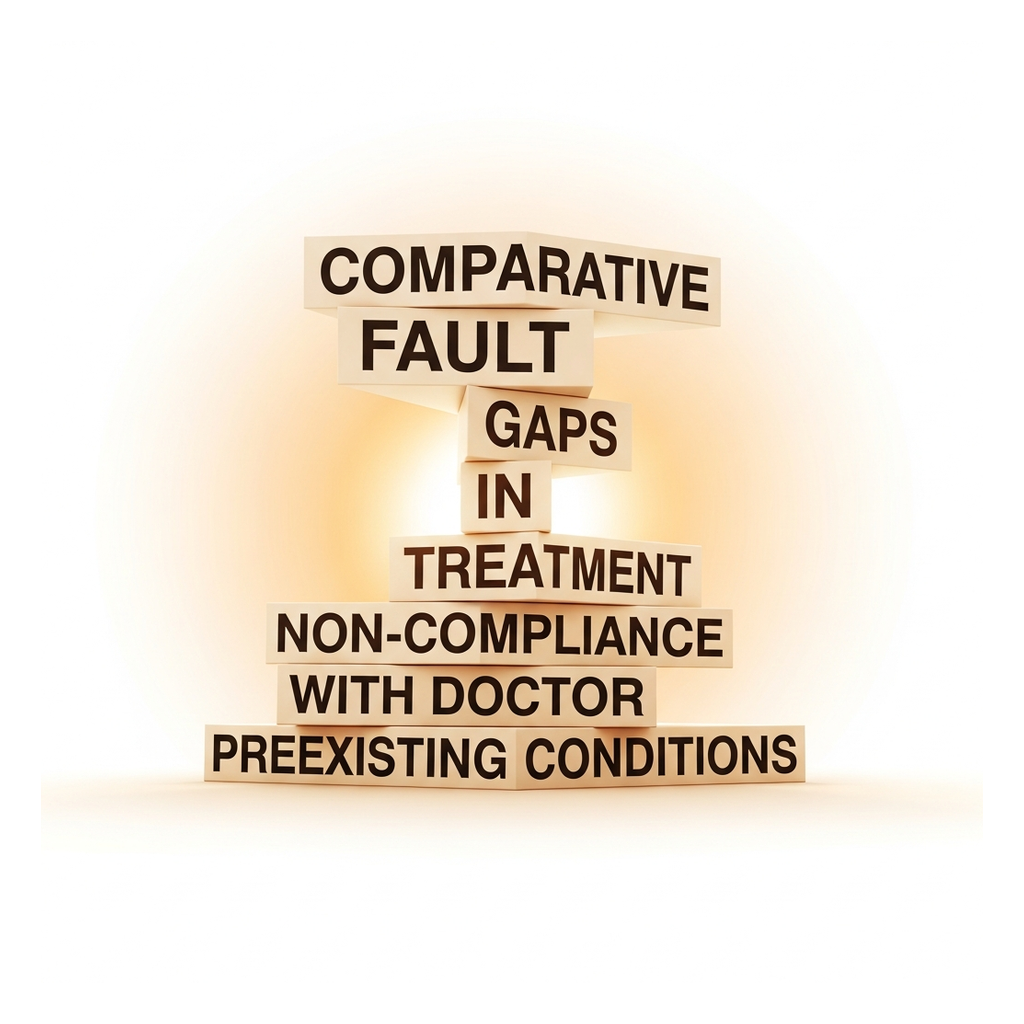
Gaps in Treatment
The first damages argument is gaps, and there are two kinds.
The first kind is the gap at the front. You did not go by EMS. You did not go for days, or in some cases weeks, before your first visit. I covered earlier in this book why that opening record matters so much, and this is the reason. The adjuster is going to point at that empty stretch of calendar and tell you it means you were not really hurt.
The second kind is the gap in the middle, and people underestimate this one. You went to physical therapy for a couple of months. Then you did nothing for several months. Then you came back into treatment. The carrier's position is simple. Something happened in between, and they are not paying for anything after that gap, because in their telling it came from somewhere else.
They do not have to prove what happened during those months. They only have to make the gap look suspicious enough that a jury wonders about it.
When People Play Doctor With Their Own Case
The next argument is non-compliance, meaning you did not do what your doctor told you to do.
The doctor recommended injections and you declined. The doctor wanted more physical therapy and you decided you had enough. You stopped treating on your own. That is a big one I get, and I understand why it happens. Nobody wants shots. Nobody wants to keep driving to appointments.
But people play doctor. They say, "No, I'm fine, I'm not going to do shots, I'm not going to do more physical therapy even though the doctor thinks I should. I'm done." Then later they want to argue they are still injured and still in pain.
Look, here is what that decision means on the other side of the table. If you stop treating, to the insurance company that means you are better. That is the whole argument, and it is a clean one for them. You told them you were healed by walking away.
The way I explain it to people is that you do not want to do any more treatment or any less treatment than you actually need. Follow the plan your doctor set. If you disagree with it, take that up with your doctor, not by disappearing.
Preexisting Conditions and the Injury They Pull Forward
The last one, and one of the biggest arguments they make, is preexisting conditions.
Say you have a history of back pain. Maybe you saw an orthopedist two years before this wreck. You have been fine since. It never comes up in your life anymore. The carrier is going to pull that visit forward and attribute your current back pain to it. That back pain now is that back pain then, not this accident, so it is not their responsibility.
And God forbid you were treating right up to the time of the wreck. That one is genuinely difficult. They have a much better preexisting injury argument, and I am not going to tell you otherwise.
Underneath all of it is the same strategy. Your injuries clearly exist, because you are getting treatment for them and the records show it. So they cannot argue you are fine. What they can do is find any excuse to say those injuries came from somewhere else or happened somewhere else, and therefore are not related to this wreck, and therefore they are not paying.
Common Questions
- Can the insurance company still blame me if the police report says the other driver was at fault?
- They can try, and they will look for a way. A police report finding the other driver at fault is strong documented proof, which is why fault arguments fail in most of our cases. I would say 90 percent plus have no real argument on those points. Their opening is usually something you said, which is one more reason to be careful with recorded statements.
- What is a gap in treatment and why does it lower my settlement?
- A gap is any stretch where you were not being treated, either before your first visit or in the middle of your care. The carrier's position is that something happened in between and they are not paying for treatment after the gap. Gaps do not prove anything, but they hand the other side a story about where your injuries really came from.
- What happens if I turn down injections or stop physical therapy early?
- The insurance company treats that as evidence you recovered. As Ted puts it, if you stop treating to the insurance company, that means you are better. People play doctor and quit when they start feeling somewhat better, then find out later they were not done. Do not do more treatment or less treatment than you need. Follow what your doctor actually recommends.
- Can they use an old back injury against me?
- Yes, and they will reach a long way back to do it. A visit to an orthopedist two years before the accident is enough for them to argue your current pain belongs to that history instead of this wreck. It is a harder fight if you were still treating for the same body part right up to the accident. That does not end your claim, but it changes how the case has to be built.
Chapter Reflection
Every argument in this chapter is really the same argument wearing different clothes. Your injuries exist. The adjuster cannot make them disappear, so instead they try to reassign them to a gap, a decision you made, or something in your past. The defense against all of it is boring and it is entirely within your control. Get treated early, follow the plan, and do not create empty calendar space. That is most of it. What decides the value of that treatment, though, is the paper it generates. That is where we go next. If a carrier is running these arguments on your file, more of Ted's answers on carrier tactics sit in the firm's learning center.