When to Call a Lawyer, and What Happens If the Other Driver Has No Insurance
The short answer to when you should call a lawyer is day one.
Now, let me draw a line that gets blurred constantly, because it is the reason people wait. Calling is not hiring. When I say call from day one, I do not mean go find someone and sign a contract this afternoon. I mean reach out, because the consultation is free and there is no obligation attached to it.
I talk to people two and three days after a wreck all the time and tell them, honestly, I do not know if you need me yet, but here are some things I want to give you. Then they make the decision. That is how it should work. You should be armed with information before you decide anything, including whether you want a lawyer at all.
This chapter covers that, the mistakes I watch people make over and over, and the one scenario where there is no good answer available.
Talk to a good lawyer. I like to think I'm the best, but I know there's other really good lawyers out there. Talk to someone who's gonna give you real honest advice. Are you ready for a lawyer at this point? You might not be.
Call on Day One, Decide Later
The reason for the early call has nothing to do with signing anybody up. It is that you do not know what kind of case you have yet.
You do not know whether yours is one of the files where a lawyer has to say, I hate to tell you this, but you need to hire us right away, because here is what could happen if you wait. There may be video on a nearby building that gets written over. There may be a defendant who needs to be put on notice to preserve evidence today, not next month. You cannot evaluate that from your kitchen table, because you do not know what the small components are.
So call. Talk to a good lawyer. I like to think I am the best, but I know there are other really good lawyers out there, and what you want is somebody who will give you real honest advice about whether you are even ready for a lawyer at this point. You might not be.
And here is my genuine bottom line, which I will give you even though it costs me business. Yes, most people are better off with a lawyer than without one. That does not mean you cannot handle it on your own if you really want to. You just need to get all the advice so you know what your options are. Then it is a personal decision, and it is yours to make.
The Two Mistakes That Do the Most Damage
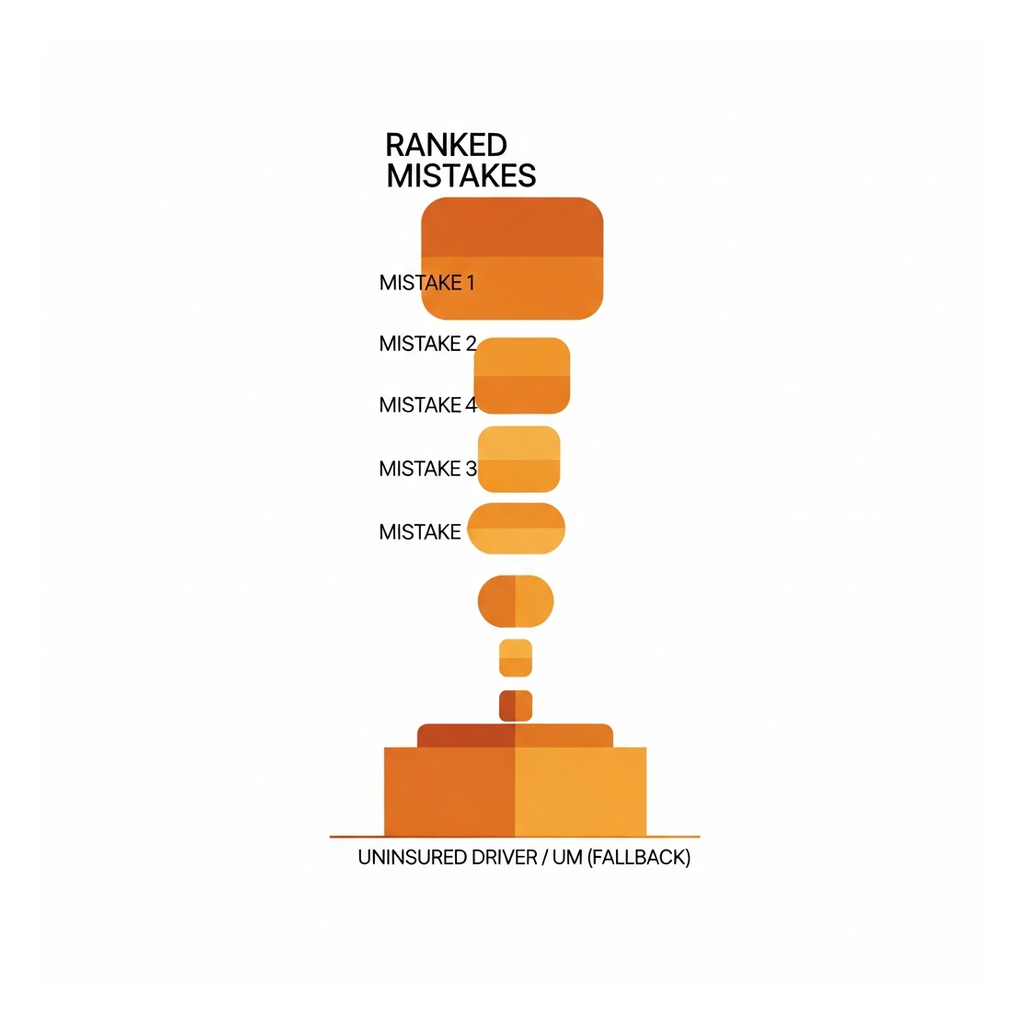
If I ranked the mistakes I see, two of them sit far above everything else.
Number one, and this is the easiest one to avoid, is not calling the police. Everything in this book about proving fault, about the officer being your best friend, about documented evidence and dates and the third party who has no stake in your claim, runs through that one phone call. It is the cheapest protection available and people skip it because the wreck looked small.
Number two is not getting immediate treatment, day of, or worst case day after, and then not following up and continuing treatment when you actually need it. The way I explain it is this. You do not want to do any more or any less treatment than you need. Not more, because that is a different problem. Not less, because the insurance company reads a stopped treatment as a healed person.
Not getting that first documented treatment early on can be a disaster for your claim in certain cases, and you have no way of knowing whether you are one of those cases. So go get checked out.
Think about what happens on the other path. You feel fine, so you wait. Five, six, seven days go by and now you are not fine. You go in, and you have handed the other side a ready made argument. You never went immediately. There is no documentation that you had neck pain or back pain the day of or the day after. It was not until seven days later, and how do we know you did not go do something else in between that caused it? Why create that fight?
Now look at the worst case on the other side. You went to the ER, you got checked out, you get reimbursed for that visit, and you are fine. That is what I actually want for people. I want you to be fine. But if you are not, you now have the proof that on day one you were already having these pains, and everything after it makes sense.
No Insurance, a Hit and Run, and Why It All Comes Down to Coverage
There are two versions of this and they end up in the same place.
Version one, the at fault driver has no insurance at all, and we know that for a fact. Version two, they fled the scene and were never found. On the hit and runs, I would put the odds of them ever getting caught at one or two percent. I have had so many of them, and it is nearly impossible unless you have video with a readable license plate that somebody can track.
Either way, you are dealing with an uninsured motorist situation.
Now, legally, you still have a right to sue the at fault party. In the scenario where you know exactly who hit you, you can absolutely file against them. But understand what you are going after at that point, which is personal assets. I have made this joke since long before he became president, and it still lands. Unless it is Donald Trump who hits you, they are not going to have personal assets.
So congratulations, you get to sue them, and you are not going to recover anything.
The only real answer is UM coverage, uninsured and underinsured motorist coverage, and you want as much of it as you can get, because in that scenario it is the only available insurance in the entire case. Georgia does not require you to carry it, and for whatever reason a lot of people do not have it. If you do not have it, you pretty much have no case. Zero, because there is no insurance to reach.
It is all about insurance. That is what I tell people, and it is the hardest truth in this book. If there is no coverage on the at fault side, and you have nothing on your own policy to protect you and your family, you are out of luck no matter how badly you were hurt or how clearly it was not your fault.
The Two Things I Want You to Remember
If somebody has just been in a wreck in Atlanta and I only get to leave them with something short, it is two things.
First, call a lawyer. I know that sounds like a marketing ploy, and I promise you it is not. Just call. There is no obligation, certainly not with our firm and not with most others either. Get some advice so you can make some decisions. That is the whole point. Whether you hire anybody is a separate question you can answer later, with better information than you have right now.
Second, do not give a recorded statement to the at fault party's insurance company. It is too early, and there is no benefit to you in it. They are good at convincing people otherwise. I have heard horror stories where adjusters flatly tell someone that the claim will be closed if they refuse to give a recorded statement. That is not true at all. That is not the law. Do not fall for it.
Common Questions
- Do I have to hire a lawyer if I call one after a car accident?
- No. The consultation is free and there is no obligation, and calling early is about information, not commitment. I tell people who call two or three days out that I do not know if they need me yet, but here are some things I want to give them. Then you decide. You can then make that decision, right? 'Cause you're armed with things.
- What is the most common mistake people make after a car accident in Georgia?
- Not calling the police. It is number one and it is the easiest one to avoid. Without an officer at the scene, you lose the independent investigator, the documented determination of fault, and the record of basic facts like what day the wreck happened. Everything downstream in your claim gets harder without it.
- How soon after a car accident do I need to see a doctor?
- Day of if you can, worst case day after. Waiting five, six, or seven days gives the other side the argument that there is no documentation of your neck or back pain at the time, and lets them ask how they know you did not do something else in between. Worst case, you went to ER, got checked out, you'll get reimbursed for that visit, and you're fine, and that's great.
- What happens if the driver who hit me has no insurance or takes off?
- Both are uninsured motorist situations. You keep the legal right to sue the at fault driver, but you are chasing personal assets, and most people do not have any. Your uninsured and underinsured motorist coverage is the only real source of recovery there, which is why you want as much of it as you can afford before you ever need it.
- Can an insurance adjuster close my claim if I refuse a recorded statement?
- No. There is no law requiring you to give a recorded statement to the at fault party's insurance company, and threatening to close your claim over it is a pressure tactic, not a legal position. I have heard adjusters tell people exactly that. It is not true and it is not the law. Decline politely and let the police report speak for itself.
Chapter Reflection
Everything in this book comes down to a handful of moments where the cost of doing the right thing is small and the cost of skipping it is enormous. Calling the police at a scene that looked minor. Getting checked out the same day when you felt fine. Looking around for a camera before the video gets written over. Getting a witness's full name instead of Bob something. Putting your own insurer on notice even when you are certain you will never need them. Buying more uninsured motorist coverage than you think you will ever use. Reading the offer on the table for what it actually is before you sign it. None of those are hard. Every one of them is the difference between a claim that stands up and a claim that quietly dies. And most of them have to happen in the first days, before you know whether any of this is going to matter. That is really why I say call from day one. Not because you need to hire anybody. Because the decisions that determine what your claim is worth are the ones you make before you know enough to make them well. For a fuller answer on when representation actually helps, see what a car accident lawyer does and Ted's closing advice in the source episode. ---