
Filing the Claim
Adjusters, the 90-Day Notice, and the Recorded Statement
You have been in the wreck. The police came. You went and got checked out. Now what?
This is the stretch where most people are operating on instinct, and instinct works against you here. The steps themselves are not complicated. You make some phone calls, claims get opened, adjusters get assigned. What matters is the order you do it in, the one call almost everybody skips, and the one thing you can politely decline that protects your case more than anything else on the list.
Now, before the mechanics, understand who you are talking to. The insurance company is not your friend. Neither is yours. That does not mean the adjuster is going to be rude or difficult to work with. Most of them are not. They have a job to do, and that job is to resolve your claim as quickly as possible for as little money as possible. It is understandable and it is not personal. But you have to know it, because it explains why you do some things and why you refuse others.
Now, this doesn't mean they're gonna be mean and super rude and difficult to work with. They may not. They have a job to do. Their job is to resolve your claim as quickly as possible for as little money as possible. That's their job, and it's understandable, and you just have to understand that and not get frustrated by it.
Call a Lawyer First, Which Does Not Mean Hire One
Who do you contact first? My answer is always a lawyer, and I know exactly how that sounds coming from a lawyer.
Hear the whole answer. Calling does not mean hiring. The consultation is free and there is no obligation, certainly with us and with most other firms. If you fully intend to handle this claim yourself, call anyway, and get free advice on how to handle it the right way before you start making calls that cannot be unmade.
The reason is simple. You do not know yet whether yours is the kind of case where something has to happen immediately. You will not know that from reading about it online. A twenty-minute phone call tells you, and then the decision is yours with real information behind it.
Opening the Claim With the At-Fault Carrier
The claim you file is with the at-fault party's insurance company. Everybody knows that part. You call them up and you give them the information they need to open a file.
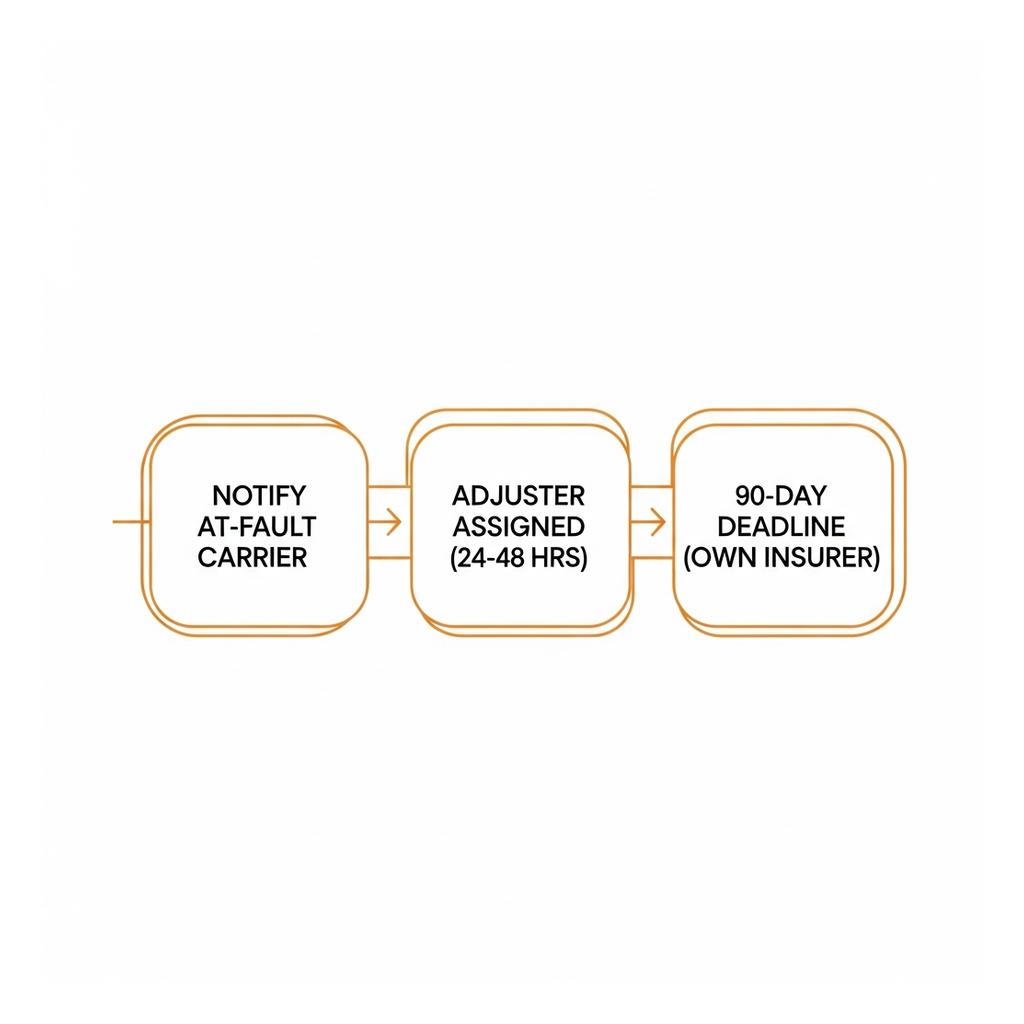
They are going to want your contact information. Where the wreck occurred and how it occurred. Your own insurance information. Any witnesses you have. They take all of that, they set up a claim, and within twenty-four to forty-eight hours an adjuster for the at-fault party's insurance is assigned to it. From that point forward, that adjuster is your point of contact on their side.
That is the straightforward half. The next call is the one people skip.
The 90-Day Notice to Your Own Insurance Company
You need to put your own insurance company on notice, and most people do not.
They skip it for two reasons that both sound sensible. Either they think reporting it will raise their rates, or they were not at fault and figure their own policy has nothing to do with it. That is incorrect.
Think back to the coverage problem. There may be a scenario, and often there is, where you have to reach your own policy for additional coverage because the at-fault party does not have enough. Early on, you have no way of knowing whether that is your case. You do not know the full extent of your injuries yet and you do not know what the other driver carries.
Here is the problem. Georgia law requires you to put your insurance company on notice within ninety days of the wreck. If you do not, your insurance company has the right to void coverage for that wreck, because you did not follow your policy and put them on notice. You could have carried UM coverage for fifteen years, paid every premium on time, and lose the benefit of it over a phone call you did not make.
So I tell people, do it every single time. Even if it turns out you never need to use it, that is great. At least they are on notice and it is there in case you need it. The process is the same as the other call. You give them the information, they assign what is called a UM adjuster, and you move forward.
The Recorded Statement You Do Not Have to Give
Right away, the at-fault party's insurance is going to ask you to give a recorded statement. There is no law that requires you to do that. The only reason they want it is to try to use it against you later if they can.
Good, honest people hear that and think, well, I have nothing to hide, I will just tell them what happened. You do not have anything to hide. That is not the risk. The risk is that the insurance company is looking for any angle, and a recording gives them something permanent to work with.
Say it was an intersection wreck. During that recorded statement you say something like, yeah, I did not see him, I guess I probably should have seen him, but then he T-boned me. You think that is harmless. You are not admitting anything. You are being a decent, forthcoming person about a moment you have replayed a hundred times.
Now watch what they do with it. Wait a minute. You said you should have seen them. I have you on a recording saying you should have seen my insured's vehicle. So had you seen them, maybe you would have avoided this. Maybe you are twenty percent at fault.
You just walked yourself into a comparative negligence argument you never meant to make. It is not what you meant and it does not matter. Anything someone says can be twisted. You do not have to do it, there is no benefit to you in doing it, so why do it?
There is one distinction that matters enormously here. You do have to cooperate with your own insurance company. Your policy says you are going to comply with them, and you do not want to give them any basis to void your coverage. The rule about recorded statements applies to the at-fault party's carrier, not yours.
When you decline, keep it pleasant and short. You tell them you do not prefer to do a recorded statement at this time, the police report will come out and it will explain everything on how this occurred, and you leave it at that.
What to Say to an Adjuster
Outside of a recorded statement, you still have to talk to these people. Keep it to the simple facts.
Here is when the wreck occurred. Here is the make, model, and year of my vehicle. Here is the damage to it. Are you injured? Yes, I am. That is the level of detail. You do not need to walk them through the headaches, then the neck, then the thing that started on day four.
What I tell people is do not fill in gaps. There is no need to say I am sorry, or I did not see them coming, or to explain why you think something happened. The less you give, the better. Give them what they need to set up the claim and pursue it, and nothing beyond that.
They are going to get the police report. They are going to get your medical records. They are going to get your bills. Let those things speak for themselves. Those documents were created by neutral professionals at the time it happened, and they make your case better than your memory of a stressful afternoon ever will.
Common Questions
- Do I have to give a recorded statement to the other driver's insurance company?
- No. There is no law requiring you to give a recorded statement to the at-fault party's insurance company, and the only reason they want it is to use it against you later if they can. Decline politely and point them to the police report. This is different from your own insurer, where your policy obligates you to cooperate.
- Do I have to notify my own insurance company if I wasn't at fault?
- Yes, and this is the step people skip. Georgia law requires you to put your own insurance company on notice within ninety days of the wreck. Miss that window and your carrier has the right to void coverage for that accident because you did not follow the policy. "I tell people, do it every single time."
- What should I say when the adjuster calls me?
- Simple facts only. When the accident happened, the make, model, and year of your vehicle, the damage to it, and yes, you are injured. Do not explain why things happened, do not apologize, and do not fill in gaps. They will obtain the police report, the medical records, and the bills, and those speak better than you can.
- Can the insurance company close my claim if I refuse a recorded statement?
- No. I have heard horror stories where adjusters tell people their claim will be closed if they will not give a recorded statement. That is not true at all and it is not the law. Do not fall for it.
Chapter Reflection
Filing a claim is mechanical. Two phone calls, two adjusters, one deadline you cannot miss. The part that decides how much your case is worth is not the paperwork. It is the handful of moments where a decent person, trying to be helpful, hands the other side something they can use. Understand what the adjuster is paid to do and you stop taking it personally, which is exactly when you start making good decisions. You are not being rude by declining a recorded statement. You are declining to volunteer for a job that is not yours. Make the call to your own carrier inside ninety days. Keep everything else to the facts, and let the record do the arguing. The recorded-statement walkthrough in this chapter is drawn from Ted's conversation on filing a claim.