
What Your Claim Is Actually Worth
The Damages Buckets
Ask most people what their car accident claim is worth and they will add two numbers together. What the body shop quoted, and what the hospital billed. That is the entire calculation in their head, and it is usually off by more than those two numbers combined.
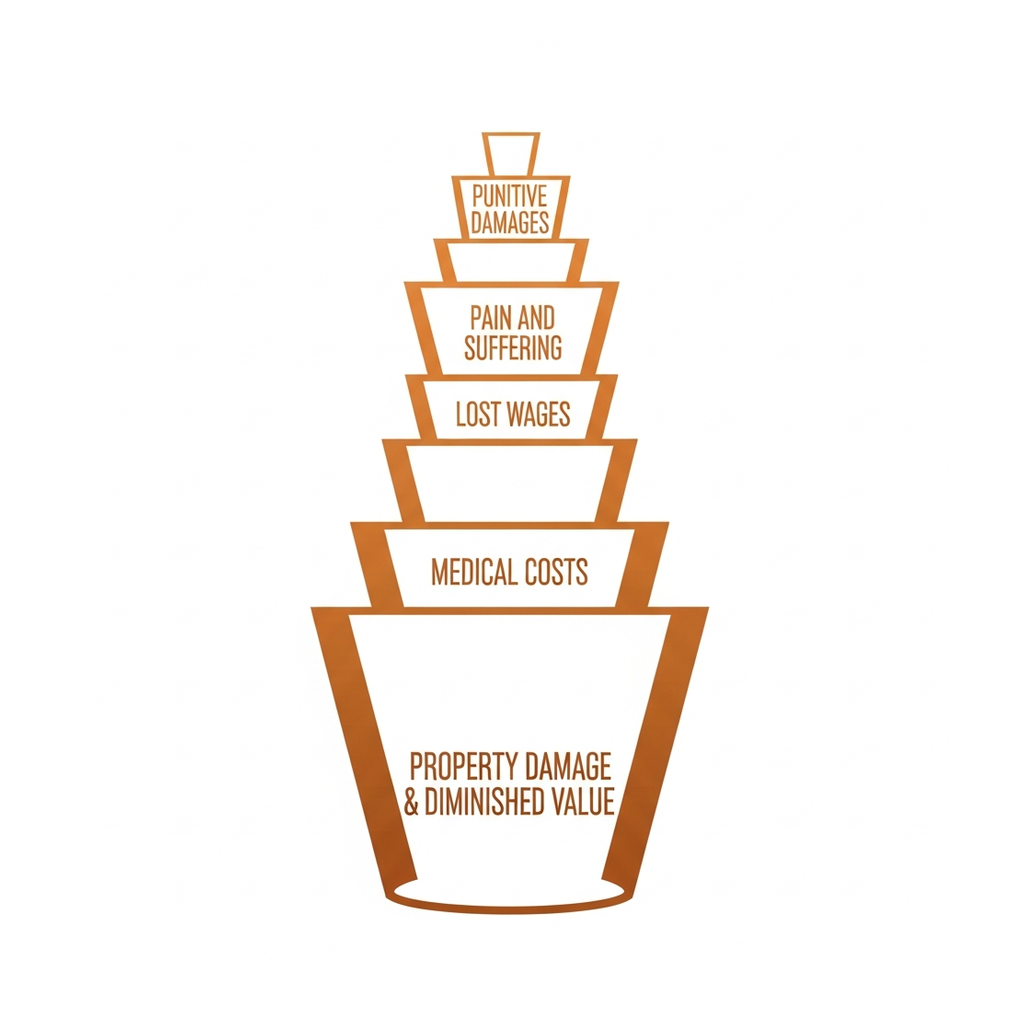
A Georgia personal injury claim is built out of separate categories that get added together at the end. Property damage runs on its own track. Medical costs are their own bucket. Lost wages are their own bucket. Pain and suffering is its own bucket, and in most cases it should be the biggest number on the page. Every once in a while there is a fourth category on the injury side, punitive damages, and that one is not about your damages at all.
Why does this matter so much? Because you cannot recover what you never counted. The adjuster handling your file is not going to walk you back through the categories you forgot. Their job is to resolve your claim as quickly as possible for as little money as possible. A claimant who asks only for repair costs and medical bills has already done half of that job for them.
So let me go through the buckets the way I go through them with a client sitting across the table at our Lawrenceville office.
Then you have what's called pain and suffering, which in my opinion, in most cases should be the biggest part of your damages. It is the loss of enjoyment of life, having to go through the physical pain, emotional pain, and again, it's past, present, and potentially future. In very severe cases, you're gonna have pain and suffering currently and for the rest of your life. More minor cases, it's all past.
Property Damage Has Two Halves, and Most People Only Claim One
Start with the car, because it is the part everybody understands first and still gets wrong.
If the vehicle is totaled, your property damage claim is the fair market value of that vehicle. Not what you paid for it. Not what you still owe on it. What it was worth the instant before the wreck happened. What I tell people is to picture a second before impact, in the condition the car was actually in, with the mileage it actually had. If you walked it over to your neighbor and sold it to them that afternoon, what would you sell it for? What would they hand you for it? That number is your claim.
Now, if the car is repairable, something changes, and this is where money quietly disappears. You do not have one property damage claim. You have two.
The first is the repair cost. That is the easy one. The estimate comes in, the shop does the work, the insurer pays the invoice, and most people believe the property side is finished at that point.
The second one is called diminished value, and a lot of people forget it entirely. Your car now has a Carfax showing it was in a wreck and was repaired. Go try to sell that car a year from now. Nobody is paying you what they would have paid for the same car with a clean Carfax. That gap, the lost value of the vehicle caused by the fact that it was hit, is real, and you have a right to recover it. It is not a bonus and it is not a favor. It is the second half of a claim you already have.
Medical Costs Run Past, Present, and Future
On the injury side, the first bucket is medical costs, and the word people skip is future.
Medical bills are past, present, and future medical costs. Some people only have past. You treated, you finished, you are better, and the file is closed. Some people are sitting right in the middle of treatment, still trying to resolve the injury, which means past and present and possibly future.
And then there is the situation people never think to account for. You may be done treating for now and still be carrying a surgical recommendation. The doctor says let us give it a year, and then in a year I want you in for the surgery. You are not in pain management today. You are not in physical therapy today. You still have a future medical cost sitting out there with a doctor's name attached to it, and it belongs in the bucket.
All of that, everything already billed and everything credibly ahead of you, goes into medical costs.
Lost Wages, and What Your Injuries Cost You for the Rest of Your Career
Lost wages work the same way, and the structure is worth memorizing because it repeats across every category.
You may have no lost wages at all. You may have only past lost wages, the two weeks you missed right after the wreck. You may have past and present, because you are still out or still on reduced hours. And you may have past, present, and future.
At the far end of that, for the rest of your life, you may have lost wages because you now have a loss of earning capacity given your injuries. That is a different thing from missed paychecks. That is the difference between the career you had and the career your body will now allow. If the injury took away work you can no longer physically do, the cost of that does not stop when you go back on payroll. All of it goes into the lost wages bucket.
Pain and Suffering Should Usually Be the Biggest Number
Here is where I part ways with how most people picture a claim.
In my opinion, in most cases, pain and suffering should be the largest part of your damages. It covers the loss of enjoyment of life. It covers having to physically go through the pain. It covers the emotional pain that comes with it. And like the other categories, it runs past, present, and potentially future.
In very severe cases, a client has pain and suffering right now and will have it for the rest of their life. That is what a permanent injury actually means in dollars.
In more minor cases, it is all past. And I want to be clear about how to read that, because it sounds like bad news and it is not. If your pain and suffering is entirely in the past, that means you are one hundred percent better and you have no pain going forward. That is perfect. That is the outcome you want. You only have past.
Add up the buckets you actually have, and that total is your personal injury claim.
Punitive Damages, the Rare Fourth Category
Every once in a while there is a fourth category, and it sits apart from everything above.
Punitive damages are a separate category for punishment. Civil punishment, for conduct by the at fault party that rises to that level. In a car accident, it is typically a DUI situation. Were they drinking? Were they on drugs? That is the fact pattern that opens the door.
Think of Tiger Woods here recently. He flipped his vehicle, hit somebody, and allegedly it was because he was on opiates. That is a DUI, and you would have a punitive damage claim against Tiger Woods at that point.
Understand what the category is for. Punitive damages are not there to compensate you for your physical damages. Those are already covered by the buckets above. Punitive damages exist to encourage people not to behave that way in the future. It is rare, but in the right scenario, it is there.
Common Questions
- Is diminished value a separate claim from the repair cost in Georgia?
- Yes. If your car is repairable, you have two property damage claims, not one. The repair cost is the straightforward one. Diminished value is the second, and it exists because your vehicle now carries a Carfax showing it was wrecked and repaired. You go to sell it a year from now, someone's not gonna pay you the same amount if it had a clean Carfax. That lost value is yours to recover.
- Can I recover future medical costs if the surgery has not happened yet?
- Yes, and this is a common gap. Future medical costs belong in your claim when there is a real recommendation behind them. You might be done with treatment, but you've got a surgical recommendation that the doc says, "Let's give it a year, but then in a year I want you in for X surgery." That puts past and future medical costs in the bucket even though you are not treating right now.
- What is pain and suffering actually worth in a car accident claim?
- There is no formula I can hand you, because it moves with the severity and the duration of what you went through. What I can tell you is that in most cases it should be the biggest part of your damages, not an afterthought added to the bills. It covers loss of enjoyment of life, physical pain, and emotional pain, and it runs past, present, and potentially future.
- Are punitive damages available in a normal car accident case?
- Rarely. Punitive damages require conduct that rises to that level, and in car accidents that typically means a DUI, so drinking or drugs. They are civil punishment aimed at deterring the behavior, not compensation for your injuries. Most claims never involve them at all.
Chapter Reflection
The number in your head after a wreck is almost always too small, and it is too small for a boring reason. You counted the two things you got paperwork for. Everything else in your claim is real, and most of it comes with less paperwork attached. The second half of the property damage. The surgery a year out. The career you can no longer physically do. The part of your life the injury took, which should usually be the largest figure on the page. Once you know what the claim is made of, a harder question shows up. Somebody is going to put a number on the table, and you are going to have to decide whether to take it. Ted walks the damages categories in order in the conversation this chapter was adapted from.