
Call the Police Every Single Time, Even for a Scratch
There is a version of this that happens every day in Atlanta. Two cars tap. Everybody gets out, everybody is walking and talking, the damage is a scrape and a scuffed bumper. And one driver says some version of, look, let's not make this a whole thing. Insurance will handle it. Here is my number.
It sounds reasonable. It sounds like two adults being efficient about a small problem. And it is the single easiest mistake to make after an accident, and one of the most expensive ones I see.
My position is that you call every single time. I do not care if it is a scratch. This is not a rule about the severity of the damage, and that is the part people get backwards. It is a rule about proof, and you do not know yet what you are going to have to prove.
Injuries can come days and weeks later. You may be feeling perfectly fine right now. 3 days later, you're not. Now all of a sudden, it's a big deal. Well, but you didn't call the police.
The Officer Is the One Thing You Cannot Recreate Later
Go back to the frame from Chapter 1. If you are truly not at fault, the police are your best friend. Here is the mechanical reason why.
The officer who comes out is the trained expert. They are required to investigate and to determine who they believe is at fault and why. That is their job, and it is a job nobody else on that road is qualified to do. When they write it down, it becomes documented proof, and now you have an independent third party saying this person is at fault and I am not.
It goes further than the report. If your case ever reaches a courtroom, that officer becomes your expert. You call them, and the jury hears it from someone in a uniform with no stake in the outcome. I found this driver fully at fault, and here is why. They ran the red light. They did not have a blinker on when they turned. That is testimony you cannot manufacture after the fact, and there is no substitute for it. When you skip the call, you are not just skipping a piece of paper. You are giving up your only neutral witness.
And even when nobody is hurt, you are not off the hook. You still have a property damage claim, and you still have to prove the other driver was at fault to collect on it.
The Case That Came Down to What Day It Happened
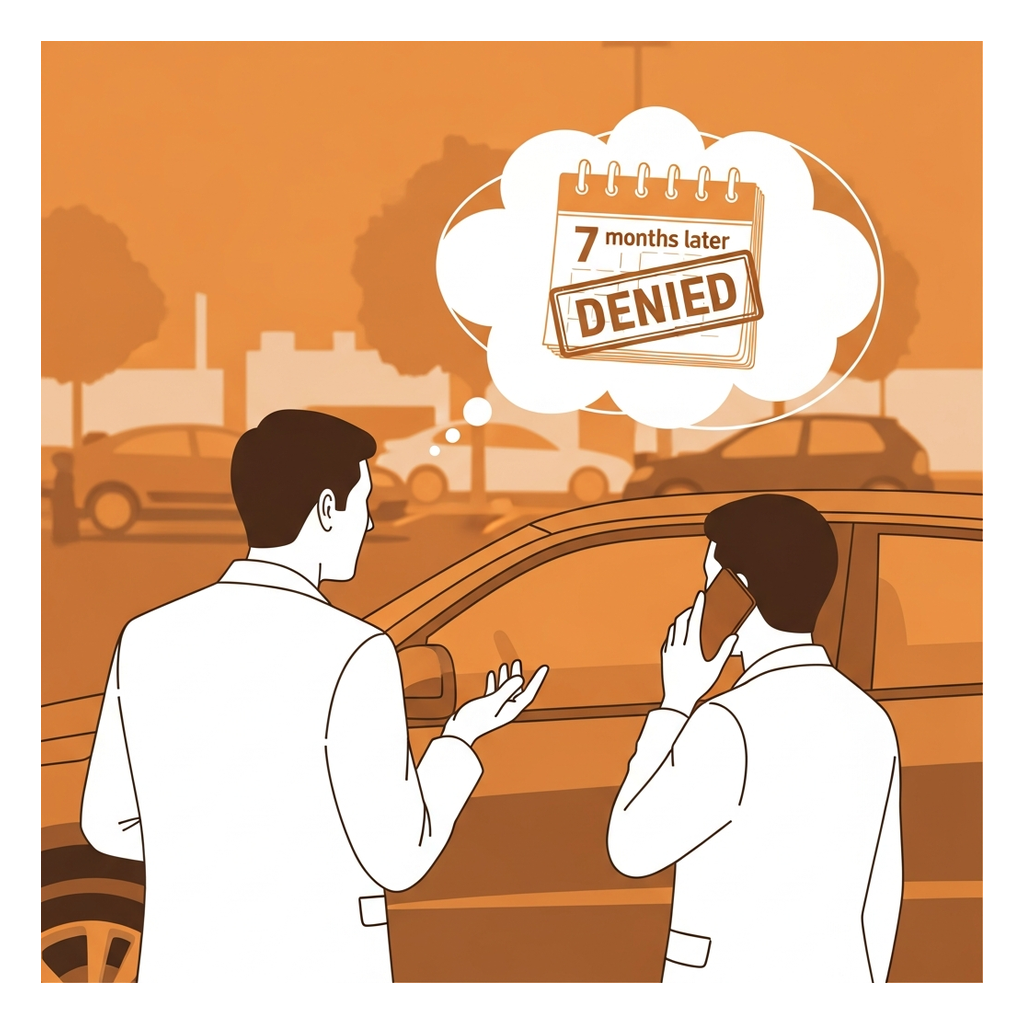
We recently spent about seven months fighting a case that started as one of these. Two vehicles going the same direction on a road with two lanes each way. One of them merges over into the other. My client is the one who got merged into, so fault is not complicated here. It was not a big accident. Some scrape damage.
They pull into a parking lot to sort it out, and the at-fault driver starts working on her. Please, let's don't call the police. Not a big deal. Insurance will deal with it. And she thought about it and it made sense to her. She was not badly injured, she did not need EMS, the damage was minor. So they exchanged information and everybody went home.
He took advantage of that. When she went to file the claim, it came down to a dispute over what day the accident happened. Not who merged into who. What day.
Why did the day matter? Because he had insurance coverage on one day and did not have it two days later. So his story is that the accident happened two days after the day she says it happened. She reported it three days later, and here is the thing about a report filed after the fact. The police can only write down what people tell them. Nobody from that department stood in that parking lot and saw two cars with fresh damage. So now we have a he said, she said fight over something as silly as the date.
It got worse. This gentleman refused to cooperate with his own insurance company. We spent seven months pushing every piece of proof we could assemble that the accident happened on the day she said it did. He never worked with his carrier. The insurance company denied coverage. No coverage means no case.
She has no personal injury claim now. She has no property damage claim she can pursue. She is completely out of luck, and all of it traces back to a decision that felt polite and efficient in a parking lot. People understandably do not think something like this is going to happen. Nobody stands there imagining that the other driver is going to lie about the calendar. Waiting on an officer feels inconvenient. What people do not realize is how inconvenient the other road can get, and how devastating.
"Nobody Is Hurt" Is Not Something You Know Yet
The second reason has nothing to do with the other driver being dishonest. It has to do with your own body.
You have adrenaline running. Your read on your own condition at the scene is close to worthless. I have had this conversation with more people than I can count, and they are normally good, rational people making what looks like a sensible call. It is not a big accident. I feel fine. We do not need the police for this.
Then three days later they are not fine. The neck stiffens up, the headaches start, the lower back that felt like nothing turns into something. Now all of a sudden it is a very big deal, and there is a claim to make. But there is no officer, no independent investigation, no documented fault determination. You made a permanent decision about your claim at the one moment you had the least information.
Look, that is the whole argument. You are not deciding whether this accident is minor. You are deciding whether to keep the option open, and the option is free.
What Georgia Actually Requires, and What the SR-13 Is For
There is a legal layer here, and I will give it to you straight, including the part that is less flattering to my own advice.
Under Georgia law, if an accident involves injury or property damage over five hundred dollars, you are technically required to report it to the police. That is the rule. Now, in practice, there is not a lot of teeth to it. People are not getting ticketed for failing to report. I have seen plenty of situations like the one I just described, and the real consequence was never a citation. The real consequence was that she could not prove fault and had no independent third party to point to.
Then there is the SR-13. That is the form a citizen fills out to report an accident when the police do not come to the scene. It is not legally required either, in the sense that nobody is writing you a ticket for skipping it. But you had better do it if you are going to pursue a claim and you are not at fault, because you need some kind of official report of this thing existing.
It matters more now than it used to. There are jurisdictions around here where police will not come out for certain accidents at all. Atlanta Police Department will not come out to an accident where there are no injuries. So what do you do when you did everything right, you called, and nobody is coming? You pull the form and you report it yourself.
Common Questions
- Should you call the police for a minor car accident in Georgia?
- Yes, every single time, even for a scratch. The severity of the damage is not what the decision should turn on. The officer's fault determination is documented proof you cannot recreate later, you still have to prove fault on a property damage claim even with no injuries, and injuries routinely surface days after the accident once the adrenaline drops.
- Are you legally required to report a car accident in Georgia?
- Technically yes, if the accident involved an injury or property damage over five hundred dollars. Being candid, there is not much enforcement behind it. People are not getting ticketed for failing to report. The real penalty is practical rather than legal. Without a report you have no independent third party, and proving the other driver was at fault gets much harder.
- What is the SR-13 form and do you have to file it?
- The SR-13 is the form a citizen fills out to report an accident when the police do not come to the scene. It is not legally required. But as I tell people, you better do it if you are going to pursue a claim and you are not at fault. It gives your accident an official record when no officer produced one.
- What if the police will not come to your accident?
- Some jurisdictions have stopped responding to certain accidents. Atlanta Police Department will not come out where there are no injuries. If that happens, you report it yourself with an SR-13, and you get even more aggressive about your own documentation at the scene, meaning video, photographs, and full contact information for every witness before anyone leaves.
- Can you still file a claim if you did not call the police?
- You can, but you are in a much weaker position, and sometimes there is no position at all. Without an officer you are in a he said, she said on fault, and the other driver's story can shift. In the case I described, the dispute was over what day the accident happened, and the coverage denial that followed left my client with nothing to pursue.
Chapter Reflection
The uncomfortable part of that seven month case is that my client did nothing unreasonable. She was standing in a parking lot with minor damage, being agreeable to a stranger who sounded agreeable back. Anyone reading this would have understood the decision. That is exactly why I say call every time. The rule has to be automatic, because the moment you are making the judgment call is the moment you know the least about how this ends. You do not know how you will feel Thursday. You do not know what the other driver's insurance situation looks like. You do not know that the fight is going to be about the calendar. The next chapter is about the evidence that is already disappearing while you are standing there, and the clock most people do not realize has started. Spaulding Injury Law handles these claims across Gwinnett County from the firm's Lawrenceville team.