
Evidence Disappears
Video, Witnesses, and the Preservation Letter
The clock starts the second the accident ends.
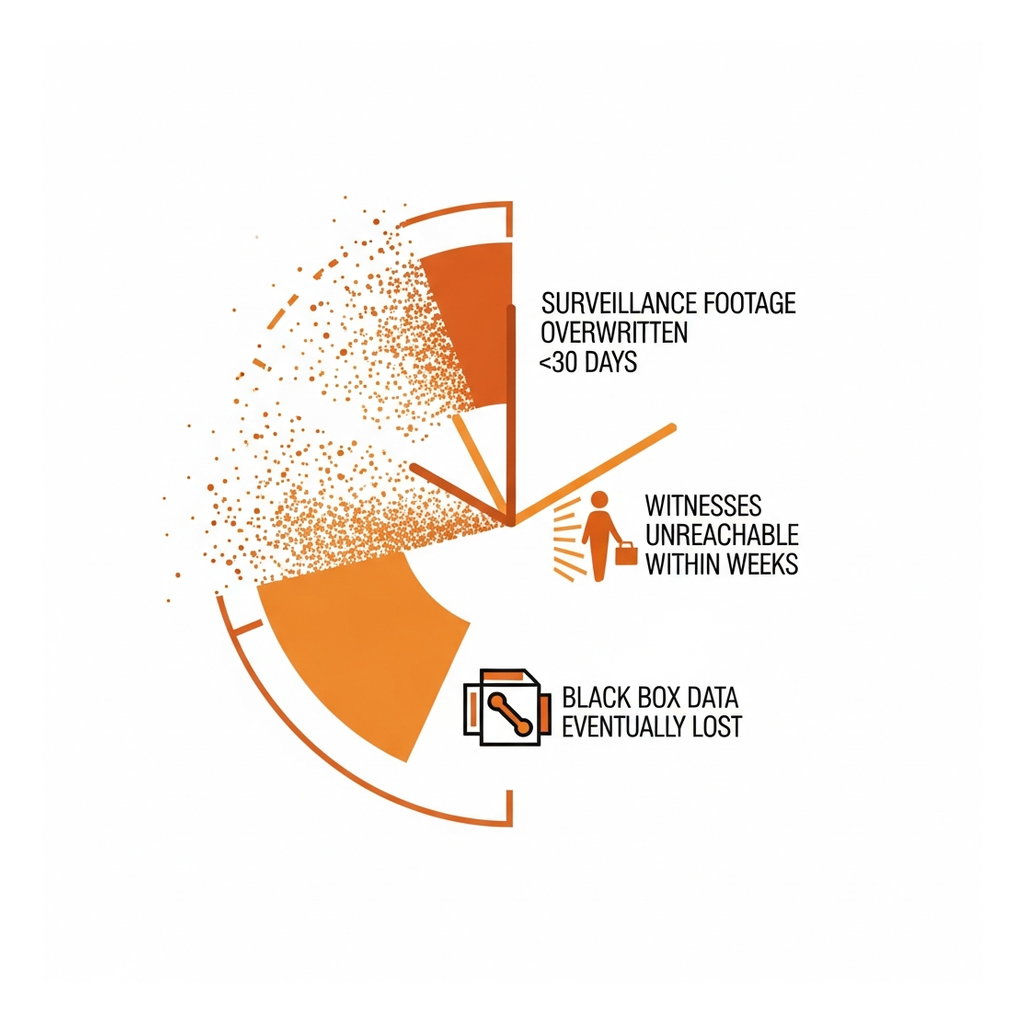
That is the part nobody tells you. You are thinking about your car, your kid in the back seat, whether your neck is going to be all right, how you are getting to work tomorrow. Meanwhile the best evidence in your case is sitting on a hard drive at a gas station a hundred feet away, and it has a delete date on it. Nobody is going to call you about it. It just quietly goes away, and thirty days later it is like it never existed.
I have had cases won outright by a piece of video, and I have had nearly identical cases turn into a coin flip because we got involved a few weeks too late. Same facts. Same injuries. Wildly different outcomes. The variable was how fast somebody moved.
So this chapter is about the evidence with an expiration date, and what you can do about it in the first day or two.
Look Around Before You Leave
While you are at the scene, take thirty seconds and actually look at your surroundings. What businesses are here? Who has a camera, and where is it pointed?
Your adrenaline is going, you are focused on the police and EMS and your phone and the other driver, and looking at the buildings around you is the last thing on your mind. But this is the highest value thirty seconds you will spend. If you are anywhere near a gas station or a bank, you can pretty much count on there being security camera footage pointed out into the parking lot. That camera does not know it is a traffic camera. It may well have caught your accident in the background of the frame.
It is rare, and I will not oversell it. Most accidents are not on video. But when it happens, it is the absolute best evidence in the case, for more reasons than one. It proves fault, obviously. It also shows the jury how violent the impact actually was, which photographs of a bumper never quite manage. You get to see it and hear it.
Now, the clock. That footage typically gets written over or deleted by the business within about 30 days. That is the outside norm from what I see. Sometimes it is 10 or 15 days. So identifying it three weeks in is not the same as identifying it on day one, and there is no version of this where waiting helps you.
Witnesses Become Ghosts
The other category is people, and people evaporate faster than video does.
I cannot tell you how many times police officers speak to witnesses, but they don't then put it on the police report, and so the witnesses just become ghosts. We can't find them. If the officer didn't get their full name, address, contact information, we're not gonna be able to find them.
So what I tell people is do not assume the police are going to talk to all the witnesses, and do not assume that whoever they did talk to made it onto the report. Get the information yourself. Full name, address, phone number, and email. Write it down or put it straight into your phone as a contact while you are standing there.
Then go one step further. If the person is willing, record their statement on your phone right there. It does not have to be formal. Ma'am, I know you saw what happened, do you mind if I record you real quick, just tell us what you saw. Thirty seconds of that is worth more than a page of your own notes, because it is contemporaneous and it is in the witness's own voice before anybody has had a chance to reconsider or get uncomfortable about being involved.
Here is the version of this call I get, and it is genuinely frustrating because there is nothing I can do with it. A client phones us 30 or 40 days after the accident. There were three witnesses, they say. They all told me the other guy was at fault, they said it plain as day, it was not my fault. Great. Who were they? Silence, and then, I do not know. I think his name was Bob something.
That is not going to help us. We need contact information, email, phone, all of it. A witness we cannot reach is not a witness.
Two MARTA Cases, Sixty Days Apart
I want to give you two cases, because side by side they explain the whole chapter better than I can.
The first one was downtown Atlanta, at an intersection. A MARTA bus blew through the red light. My client was coming from the side road, making a left hand turn in front of the bus, and he had the green. Police show up, and the bus driver lies. No, I had the green light, he ran the red.
Now it is a he said, she said, and put yourself in the officer's position for a second. Two people, two opposite stories, nothing else to go on. So what does the officer do? I do not know who did or did not. I am going to write you both at fault, and y'all can go fight it out in court. They both got tickets.
Here is what saved it. He called right away. And what a lawyer can do at that point is send what is called a preservation of evidence letter, in this case to MARTA. That letter puts them on formal notice to preserve the video. Because MARTA buses carry 16 to 17 different camera views, inside the vehicle and out. The footage exists. The only question is whether it still exists 30, 40, 50, 60 days from now, and whether anybody ever told them in writing not to let it go.
We got the video. And the video showed the light red, and it showed her literally looking off sideways and driving straight through it. End of story. His ticket got dismissed, and we had full liability on MARTA in a very good case, because we had it on tape.
Second case, similar facts. But this client did not call us for 60 days. We get involved, and we immediately do the letter, hoping it is all still there. What came back from MARTA was this: yes, there was video, but when we went to download it, it was damaged. Three or four days after our letter. So there is no video. We are back to he said, she said, fighting about fault we never should have had to fight about.
And the difference between those two cases is not a small difference in value. It is a completely different case. In the first one, nobody could argue about the red light. In the second one, we spend the life of the file arguing about it, and every dollar of that case gets discounted for the risk that a jury splits fault down the middle.
There is a second effect to the letter that people miss. Once that letter is in their hands, they lose the ability to shrug about missing footage. You got our letter. We told you to preserve it. You did not do it. That is suspicious, and now you can use it against them. Without the letter, you have no right to stand up and say they are hiding something.
Call a Lawyer Even If You Never Hire One
This is where I land, and I understand how it sounds coming from a lawyer, so let me be clear about what I am actually saying.
Call a lawyer. You do not have to sign up with them if you do not want to. The consultation is free. With our firm there is no fee and no obligation for that initial call, and most other firms will tell you the same.
The reason is not that you need representation on day two. Often you do not, and I tell people that directly. I am regularly on the phone with someone two or three days after an accident telling them I am not sure you need me yet, but here are the things you need to know. The reason to call is that you have no way of knowing whether yours is one of the cases where somebody has to move right now to secure evidence. That is not a judgment a person can make about their own accident, because it requires knowing what to look for.
Is this a MARTA case? Is there a camera on that building? Is there a commercial vehicle involved with a system that overwrites on a schedule? A lawyer can tell you in ten minutes whether the answer is, you are fine, take your time, or, I hate to tell you this, but you need to hire someone right away, and here is exactly what happens if you do not. Either way you walk away armed, and the decision about whether to hire anybody stays yours.
Common Questions
- How long do businesses keep security camera footage of a car accident?
- Typically about 30 days before it gets written over or deleted, and sometimes as little as 10 or 15. That is the outside norm from what I see. Gas stations and banks nearly always have cameras pointed out into the parking lot that may have caught your accident in the frame. The window to identify and request it is short.
- What information should you get from a witness at the scene?
- Full name, address, phone number, and email, collected by you rather than left to the officer. Write it down or put it in your phone as a contact. Then, if they are willing, record a short statement on your phone about what they saw. Officers frequently speak to witnesses without putting their information on the report, and after that we cannot find them.
- What is a preservation of evidence letter?
- It is a letter a lawyer sends putting a company or agency on formal notice to preserve specific evidence, most often video. It does two things. It gets the footage secured before the system overwrites it, and if the evidence disappears anyway, the letter is proof they were warned, which you can then use against them.
- Do you have to hire a lawyer just to get evidence preserved?
- No. As I tell people, just call a lawyer, you don't have to sign up with them if you don't want to, the consultation's free. The point of the call is to find out whether your case has a piece of evidence on a deadline. Often the answer is that you have time and can decide later. Sometimes it is not, and you need to know which one you are.
Chapter Reflection
The two MARTA clients had roughly the same accident. One of them has a dismissed ticket and a clean liability case. The other spent his case arguing about a red light that a camera already answered, on footage that got damaged three days after we asked for it. Nothing separated them except sixty days. That is really the whole point of this chapter, and it is why I push people so hard on making one phone call early. Not because you need to hire anybody, and not because every case has a ticking piece of evidence in it. Most do not. But you cannot tell from the inside which kind you have, and the cost of finding out is a free conversation. Once the evidence is gone, no amount of good lawyering later puts it back. Ted walks through both MARTA cases in Episode 2 of the Atlanta Car Accident Attorneys podcast.